

This guide explains what happens during the ANDA process, from making an application through to moving in, ongoing support, and how to raise concerns if needed.
All family’s circumstances are unique. While we aim to follow the process set out in this guide, timescales and outcomes will vary depending on individual needs, property availability, technical requirements and statutory approvals.
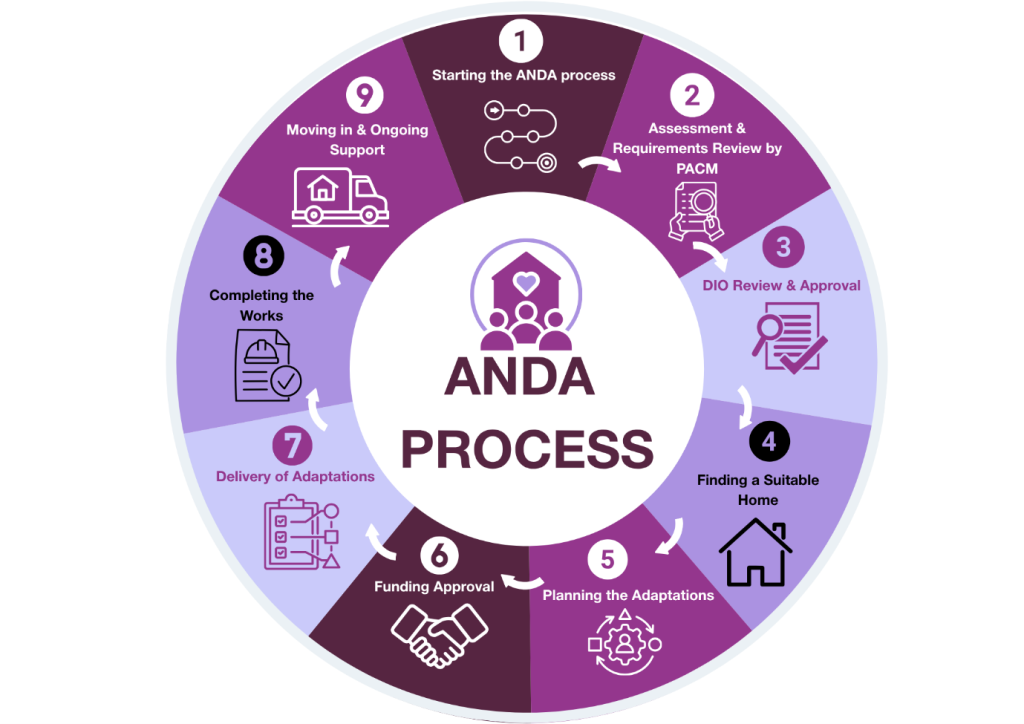
The ANDA process begins by contacting the Pinnacle Service Families Helpdesk, which manages ANDA applications on behalf of the MOD.
If you are planning to move to a new Service Family Accommodation (SFA) property, it is important that you tell us about any special requirements for your new home at the point of your housing application by selecting an ANDA application.
If you already live in SFA and your circumstances have changed, for example if your medical needs have altered or you now require adaptations to your current home, you should contact Pinnacle by completing the Additional Needs and Disability Adaptation Request Form.
In both circumstances, to formally begin the ANDA process, you will need to submit a completed ANDA Assessment Form, along with supporting medical from a clinician and/or Occupational Therapy (OT) evidence. Once this information is received, Pinnacle will appoint a dedicated Pinnacle ANDA Case Manager (PACM) who will be your main point of contact throughout the process.
Providing clear and detailed information early helps ensure that a suitable property can be identified and that any required adaptations are properly considered. More information about this process can be found in the Tri‑Service Accommodation Regulations (JSP 464 Volume 1, Part 2, Chapter 6, Annex C).
Your PACM will review the information you have provided to make sure it is complete and clear. If anything needs clarification, they will contact you directly and, where necessary, liaise with the OT or clinician who provided the supporting evidence.
The PACM will work with you to fully understand your family’s needs and will then complete an ANDA Requirement Form (ARF). This document sets out the assessed requirements and is submitted to DIO for consideration.
The DIO ANDA Team will review the ARF alongside the supporting medical and OT evidence, ensuring that each requirement is assessed against JSP 464 and wider accommodation policy.
DIO will confirm which requirements are approved and will clearly explain if any aspects cannot be supported or require further clarification. The outcome of this review is passed back to your PACM, who will explain the decision to you via email. Where an ARF is approved, you will be provided with clear information about the next steps in the process.
Once requirements are approved, the PACM will consider the most suitable housing option for your family. As a first step, they will look for SFA properties within your normal entitlement that already meet, or can safely support, the assessed needs. Where suitable homes exist within entitlement, these will always be prioritised.
If you already live in SFA, the PACM and Amey or VIVO will consider whether the required adaptations can be delivered while you remain in the property. A scoping visit may be arranged to assess feasibility. If this is not possible, alternative properties will be assessed for suitability.
Because of the specialist nature of identifying accommodation that safely meets assessed needs, there may be only one suitable property available within the housing stock, and therefore you may only receive one offer of housing. Any property offered will have been carefully assessed against the agreed clinical and functional requirements of the household.
Under JSP 464 you may be eligible for one paid visit to view the property and, where appropriate, this may include the Occupational Therapist to support assessment of suitability.
Once a suitable property is confirmed, it is allocated through the E1132 process. If the required adaptations are minor and can be completed within a standard 20 working day void period, a Move In appointment will be arranged.
For other cases, you will receive weekly updates from the PACM and a Move In appointment will be arranged once VIVO or Amey confirms completion of the required work.
Where adaptations are structural or complex, detailed designs will be developed, supported by any necessary surveys such as structural, asbestos or electrical assessments. All designs are completed in line with the Building Safety Act 2022, relevant Building Regulations and DIO policy.
You may be asked about day-to-day living needs to provide context however, final design decisions are made by qualified specialists and/or the Occupational Therapist. Family preference cannot override clinical need, technical feasibility or statutory safety requirements.
DIO has a legal responsibility as landlord to ensure that Service Family Accommodation remains safe and compliant with applicable legislation. While family and clinical needs are central to the assessment process, all proposed adaptations must also meet building safety requirements, technical standards and statutory obligations. In some cases, this may affect how an adaptation is delivered or whether alternative solutions are required.
the home is scoped and any required design work is complete, the cost of the works will be calculated.
- Minor adaptations are usually approved quickly. Once a Statement of Need and estimated cost have been provided by Amey or VIVO, DIO will review the proposal against the approved requirements and, where appropriate, authorise the works and funding. Approval is typically completed within one week.
- Major or complex adaptations require a more detailed MOD approval process. Proposals are reviewed by a number of specialist teams within DIO to ensure they meet approved clinical requirements, comply with policy and legal obligations, and demonstrate the responsible use of public funds. To support this process, Amey or VIVO may need to obtain contractor quotations and undertake further surveys or assessments, which may require access to the property.
Because major adaptations often involve multiple specialist reviews, technical assessments and funding approvals, this stage can take between six weeks and six months, and occasionally longer for the most complex cases. Throughout this process, your PACM will provide regular updates on progress and discuss any available support or next steps with you as required.
Once funding is approved and works are formally instructed Amey or VIVO, will engage the necessary subcontractors/specialists and share a provisional schedule of works, including the sequence of activities, expected timelines, survey requirements and any periods of likely disruption.
- In-occupancy adaptations, If adaptations are taking place while the family remains in the property, suitable access times will be agreed, taking account of household routines, access limitations and individual needs. Where works would cause major disruption or restrict safe use of essential facilities, the PACM will explore whether temporary measures or accommodation may be needed during delivery. In some cases, adaptation works carried out in an occupied property may require families to move into temporary accommodation for a period of time to ensure safety and minimise disruption. Where families remain in the property during works, suitable access arrangements will be agreed, and any site safety measures must be followed to help keep everyone safe while works are underway. These decisions are made on a case-by-case basis, in line with medical need and policy
- Minor adaptations examples include but are not limited to grab rails, handrails, lever taps, window locks, minor flooring changes, fencing. Subject to availability of materials and contractors, these are typically delivered in a shorter period often within the standard 20 Working Days void period or similar.
- Major adaptations examples include but are not limited to accessible bathroom installations, level‑access showers, permanent ramps, external access redesign, kitchen alterations for accessibility, specialist equipment such as through‑floor lifts.
These works are more complex and may require multiple trades, bespoke equipment, statutory compliance checks and additional surveys. Expected timelines for major adaptations can range from six weeks to six months.
We will always aim to complete the adaptation work as quickly as possible, however you should be aware that manufacture or sourcing of specialist items (e.g., bespoke ramps, lifting equipment), supply chain constraints, installer availability, further structural, electrical, compliance surveys and building safety inspections can extend delivery timelines. You will receive weekly updates from the PACM throughout and will be provided with details of a schedule of works and anticipated completion date. As works progress and once we are confident in an anticipated completion date, the PACM will arrange a Move‑In (MI) appointment.
Important: Throughout all works, adaptations will only be delivered in accordance with the approved scope of works. Additional upgrades or preferences outside the assessed clinical need cannot be funded through the adaptation programme without prior review and approval. If clinical needs or circumstances change during the process, please inform you PACM so that the requirement can be reviewed and appropriate advice provided.
Once all works are complete, a final inspection takes place to ensure adaptations meet approved needs and required standards. Training will be provided for any specialist or fixed equipment, such as stairlifts.
Where specialist equipment has been installed, such as a stairlift or other fixed equipment, guidance will be provided on its safe operation and use.
Following completion of the adaptations, or after you move into an adapted property, any concerns should be raised with your PACM in the first instance so that they can be addressed promptly.
Immediately after Move In or completion of in-occupancy works, any issues should be reported to the PACM, who will ensure they are addressed promptly.
During ongoing occupancy, any issues with ANDA adaptations or equipment should be reported to the Pinnacle Repairs Helpdesk on 0800 031 8628.
VIVO or Amey remains responsible for maintaining ANDA adaptations and equipment.
You will be invited to complete an ANDA Satisfaction Survey once works are complete. This feedback is vital in improving the service and shaping future delivery.
Your feedback is extremely important to us. It helps us understand what has worked well, identify opportunities for improvement and ensure that the experiences of Service families continue to shape the development of the ANDA service.
Concerns can be raised at any time and will not affect entitlement to support. You are encouraged to raise issues with your PACM first so they can be resolved quickly. If needed, a Stage 1 complaint can be made via Pinnacle, with the option to escalate to a Stage 2 complaint to DIO for independent review.
You do not have to navigate the ANDA process alone. A number of organisations are available to provide independent advice, guidance and support throughout your adaptation journey.
These include:
- Naval Families Federation (NFF)
- Army Families Federation (AFF)
- RAF Families Federation (RAF FF)
- Forces Additional Needs and Disability Forum (FANDF), delivered through SSAFA
These organisations can help explain the process, answer questions and support you in raising concerns or seeking additional assistance where required.
You can also access support locally through your Unit Welfare Team, Service Families Housing Officer (SFHO) or Military Housing Liaison Officer (MHLO), who may be able to provide assistance based on your family’s individual circumstances.
These organisations are recognised within JSP 464 Volume 1 and play an important role in helping Service families navigate the ANDA process and ensure that your needs are effectively communicated.